
How To Build Game Changing Power
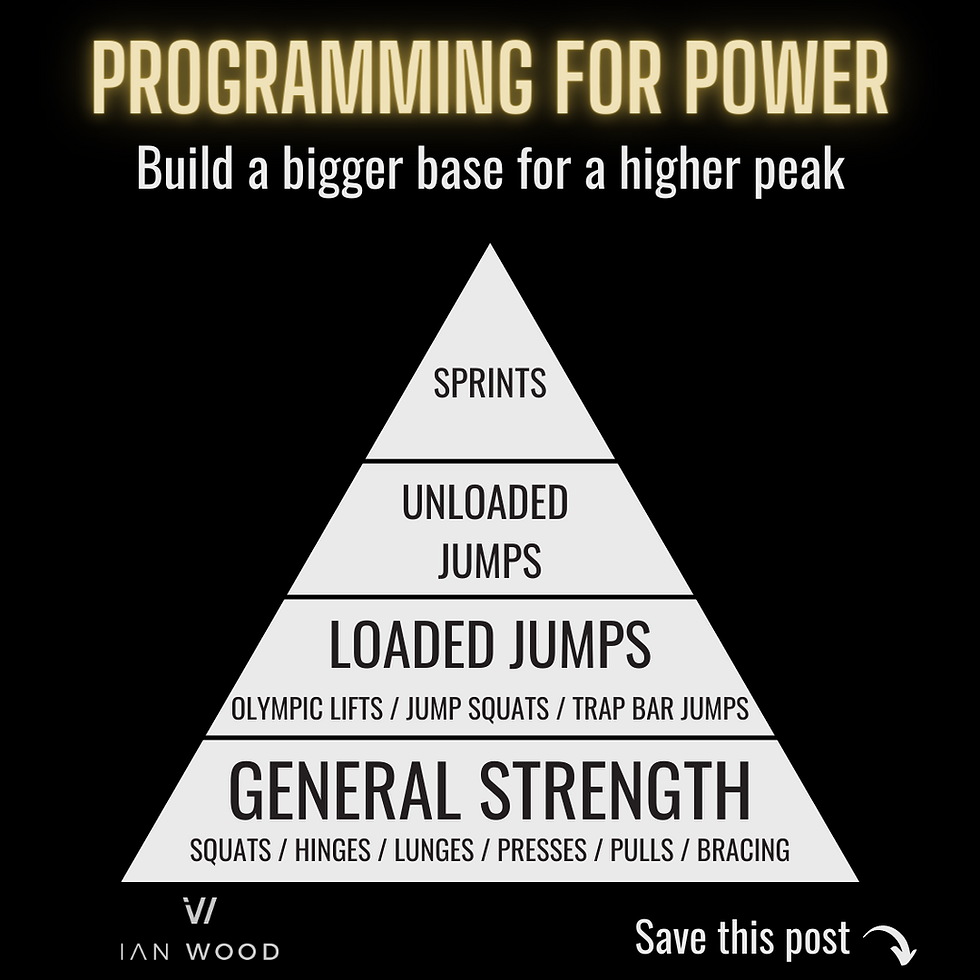
When it comes to being a great athlete in your sport, or to simply becoming an absolute weapon in the gym amongst your group of friends, the biggest game changer is more often than not explosive power.
The power that allows you to dominate contact and go through people like Manu Tuilagi.
The power that allows you to evade contact and glide past the opposition like Kylian Mbappe.
The power that means that even if your opponent knows what you're going to do, they can't stop it, like LeBron James.
Or the power that makes your heavy squat move twice as fast as you best mates and makes them do a double take.
So I'm going to go into a little more detail on each step of this pyramid to help you understand what you might be lacking in your own training, and how best to improve it. General Strength We always start at the base of the pyramid, because the bigger the base the higher the potential for your peak at the top. And in terms of power, the base is general strength in squats, deadlifts, presses, rows, pull-ups and abdominal bracing. Getting really strong in these movements increases the overall amount of force you can produce, which is important as the equation for power is "Force x Speed = Power". Increase the force you can produce, increase your power. These movements are less specific, don't have to look like your athletic movements, and can be done throughout a programme for multiple sets and reps. Remember, general strength is general, so you can generally do it quite generally. That's the general point. Just get generally stronger. Loaded Jumps Remembering the power equation of "Force x Speed = Power", now that we've increased our force, we need to increase our speed. Loaded jumps are great for this as we are still working under load, but focussing on how quickly we can move it from A to B, rather than how much we can move from A to B. You can use a load of approaches for this, from Olympic cleans, snatches and jerks, to jumps squats, to trap bar jumps. And remember, the higher the weight, the slower the speed, so depending on your strengths and weaknesses you might want to move a really light load super quickly, or a heavier loads that travel slower. Here's a little visual to help pick some suitable movements: QUICKEST
Medicine Ball Scoop Toss
Light Repetitive Jump Squats
Power Snatch
Light Trap Bar Jump
Power Clean
Heavy Trap Bar Jump
SLOWEST You may not do these quite as often as you'll need to be well rested, but they're still form a big part of your training. Unloaded Jumps Unloaded jumps are something you don't see in people's exercise repertoire outside of their school years. We age, and for some reason our feet stop leaving the floor and we can't exercise without load. But they're essential if you want to develop explosive power, and continue to work on the speed element of the power equation. Taking off the load allows us to move even quicker, and utilise the elastic qualities of your muscles and tendons. Take a second to watch these videos of two of the most impressive and powerful feats of athleticism in training on the internet from Stefan Holm and Werner Gunthor. Moving at such speed for repeated jumps, bounds and skips, where your foot is in contact with the floor for 0.2s or less allows you to utilise the stored energy in your tissues, add it to your muscular strength, and generate even more power. This is the basis of "plyometrics", and every great explosive athlete you can think of from weightlifters to sprinters will be using them. You normally layer these on top of your general base strength and choose a few key movements that carry over specifically to your sport rather than do every plyometric under the sun. Sprints Finally, the top of the pyramid is sprints. While every other step of the pyramid refers to types of exercises, the top is specifically sprints simply because they cannot be replaced with anything else. In most sports, the most killer use of power is sprint speed. It is a skill as much as a physical quality. No jump, throw, snatch, or squat will come remotely close in terms of speed and maximal velocity. No other plyometric will come close in terms of quick foot contact and reactive speed. Simply put, if you want to move fast, you gotta move fast, and there's nothing faster than a sprint. And nowhere near enough people do them. If you can add them into your training in a smart and structured way, you'll have a real head-start on your opposition.


Comments